Older than Canada. Older than the record.
Lacrosse was a gift, a ceremony and a medicine long before it was a sport, a league, or a Sunday night in Durham Region. Every claim on this page shows its source.
Older than the record of it
The game is older than any European account of it. Indigenous nations were playing it long before anyone wrote it down.[9]
Traditional games could draw thousands of players, across fields that ran for several kilometres, over several days.[9]
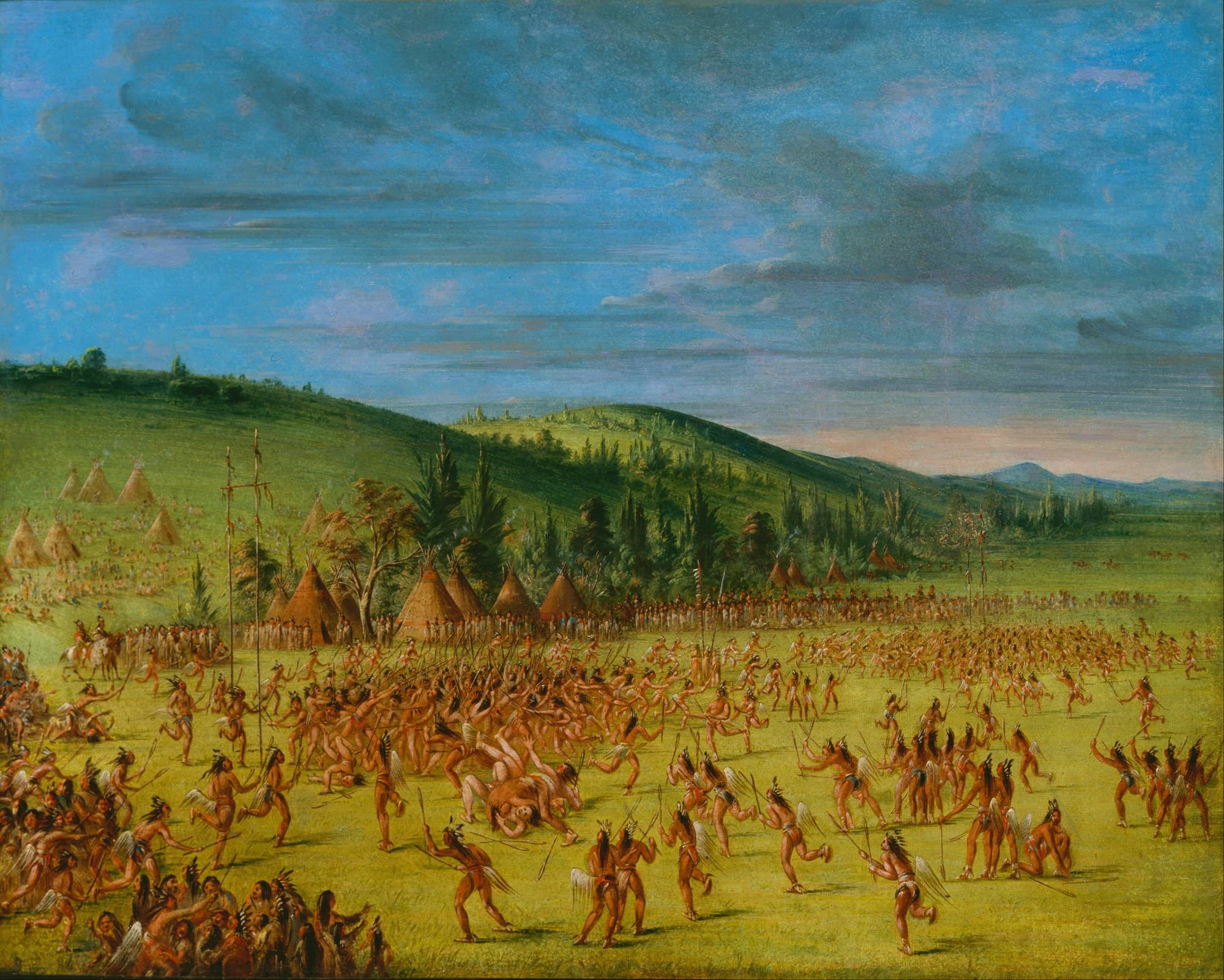
George Catlin painted this after travelling among Choctaw communities in the 1830s. It is one man's depiction, made for audiences far away — not a photograph, and not a neutral record. What it does show is the scale: hundreds of players at once, on ground far larger than any field we play on now.[1]
The Medicine Game
The Onondaga Nation describes lacrosse as a game given by the Creator, to be played for the Creator, and known to have healing power. That is why it is also called the Medicine Game.[6][8]
This is not something that stopped. The Haudenosaunee hold that the game gives medicine to the people who play it, and it is played that way now.[7][6]
We are a winter league in Durham Region. We are not the keepers of any of this, and we make no claim on it. We think anyone who picks up a stick should know whose game they are playing.
Three nations, three words
The game has many names, because many nations played it and still do. Below are three, spelled as their sources spell them.
Centuries of it, before any of the dates below. How many is not ours to put a number on, and no honest ruler can draw it to scale next to what follows.
1763On 2 June 1763 about four hundred Ojibwa men took the British fort at Michilimackinac.Read more
The attack opened as a game of baggatiway, staged in honour of King George III's birthday.[5]
1869The same book carried this law: “No Indian must play in a match for a white club, unless previously agreed upon.” The people who created the game were written out of the rules of it..
1983The Haudenosaunee Nationals were founded in 1983 to compete as a nation, not as part of one — the only Indigenous team playing at that level as a sovereign people..
1994The law that names lacrosse a national sport of Canada passed in 1994, not 1867.Read more
It is the National Sports of Canada Act: hockey in winter, lacrosse in summer.[4]
2028Lacrosse returns to the Olympic Games in Los Angeles in 2028, six a side.Read more
Whether the people who created the game will be there under their own flag is still not settled.[7]
What got written down
French missionaries wrote the first European accounts in the 1630s. The name almost everybody uses today came from them, not from the people who created the game.[9][note]
On 2 June 1763 about four hundred Ojibwa men took the British fort at Michilimackinac. The attack opened as a game of baggatiway, staged in honour of King George III's birthday.[5]
The details everyone repeats — weapons hidden under blankets, a ball thrown over the wall — come from accounts published long afterwards.[5][note]
Written down, and written out
William George Beers, a Montreal dentist, started writing the rules down in 1860 and published the first full rulebook in 1869: twelve players a side, a hard rubber ball in place of deerskin. He helped found the National Lacrosse Association in 1867.[10][9]
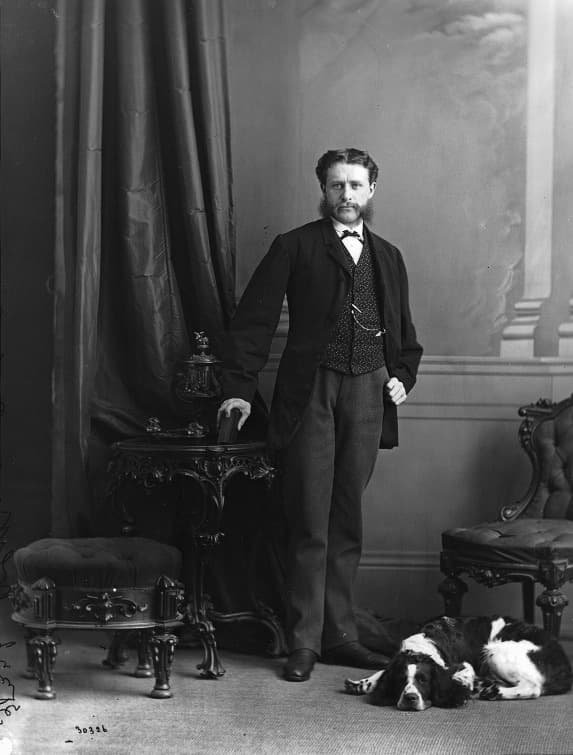
William George Beers, photographed in Montreal two years before he published the rulebook quoted above.[2]
The same book carried this law: “No Indian must play in a match for a white club, unless previously agreed upon.” The people who created the game were written out of the rules of it.[15]
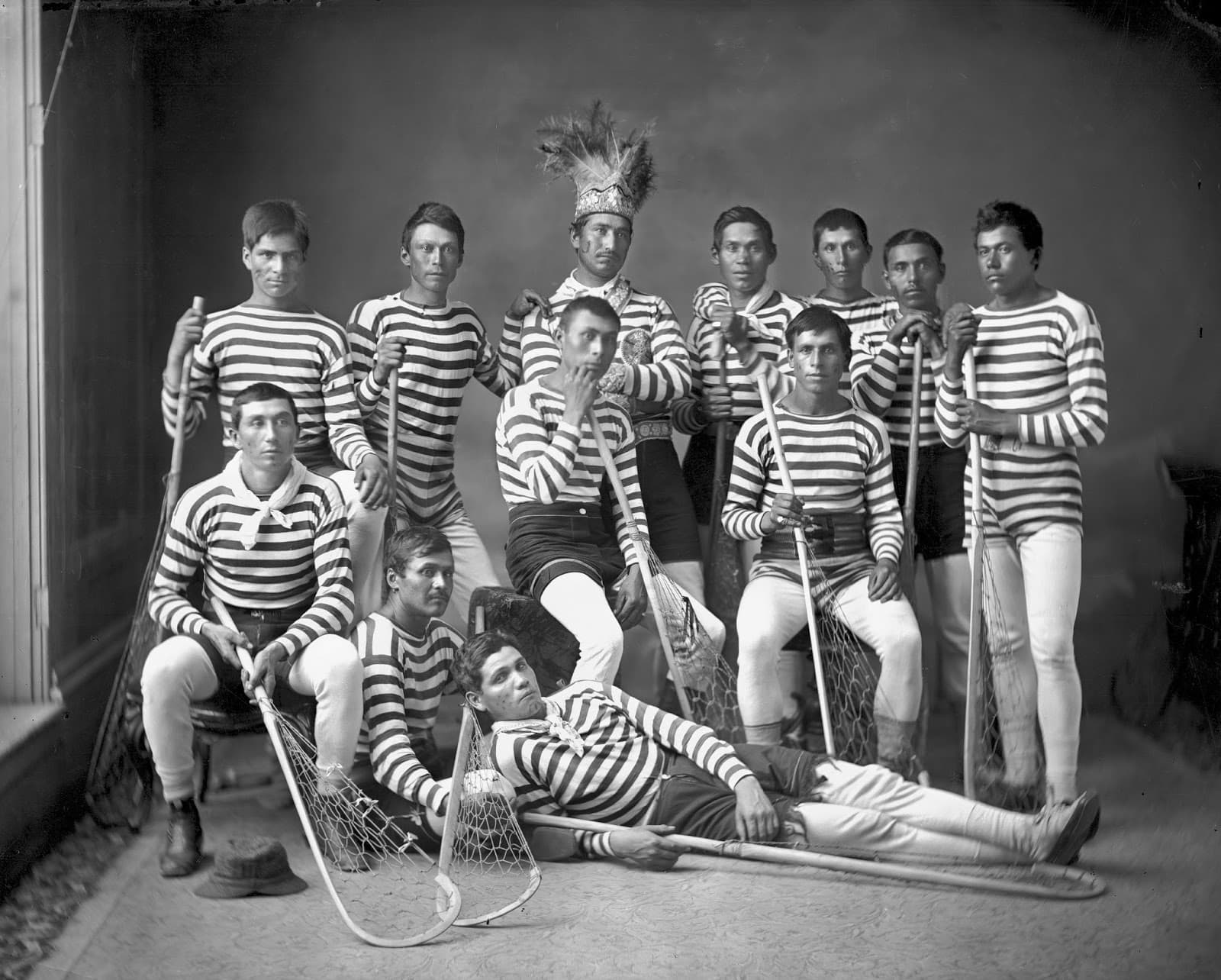
A Kahnawà:ke team, photographed in Montreal in 1876 — seven years after Beers's rulebook put in writing that no Indian was to play for a white club. We could not establish the names of these men, or what the man in the headdress was to the team, so we have not guessed at either.[3]
The historian Allan Downey, who is Dakelh, puts it plainly: Indigenous players were “banned from lacrosse organizations, pushed out and generally not a part of lacrosse’s development in Canada and the U.S.” The Haudenosaunee Nationals say the same on their own site — banned from international competition for over a century, and still fighting for inclusion.[14][3]
What Canada actually declared
The law that names lacrosse a national sport of Canada passed in 1994, not 1867. It is the National Sports of Canada Act: hockey in winter, lacrosse in summer.[4]
1763
On 2 June 1763 about four hundred Ojibwa men took the British fort at Michilimackinac.
1931
The first professional indoor season ran in 1931.
1994
The law that names lacrosse a national sport of Canada passed in 1994, not 1867.
2028
Lacrosse returns to the Olympic Games in Los Angeles in 2028, six a side.
Their own flag
The Haudenosaunee Nationals were founded in 1983 to compete as a nation, not as part of one — the only Indigenous team playing at that level as a sovereign people.[11][8]
In 2010 they could not reach the world championship in Manchester. Britain would not accept Haudenosaunee passports, and the players would not travel on anyone else's.[11][17]
How it came indoors
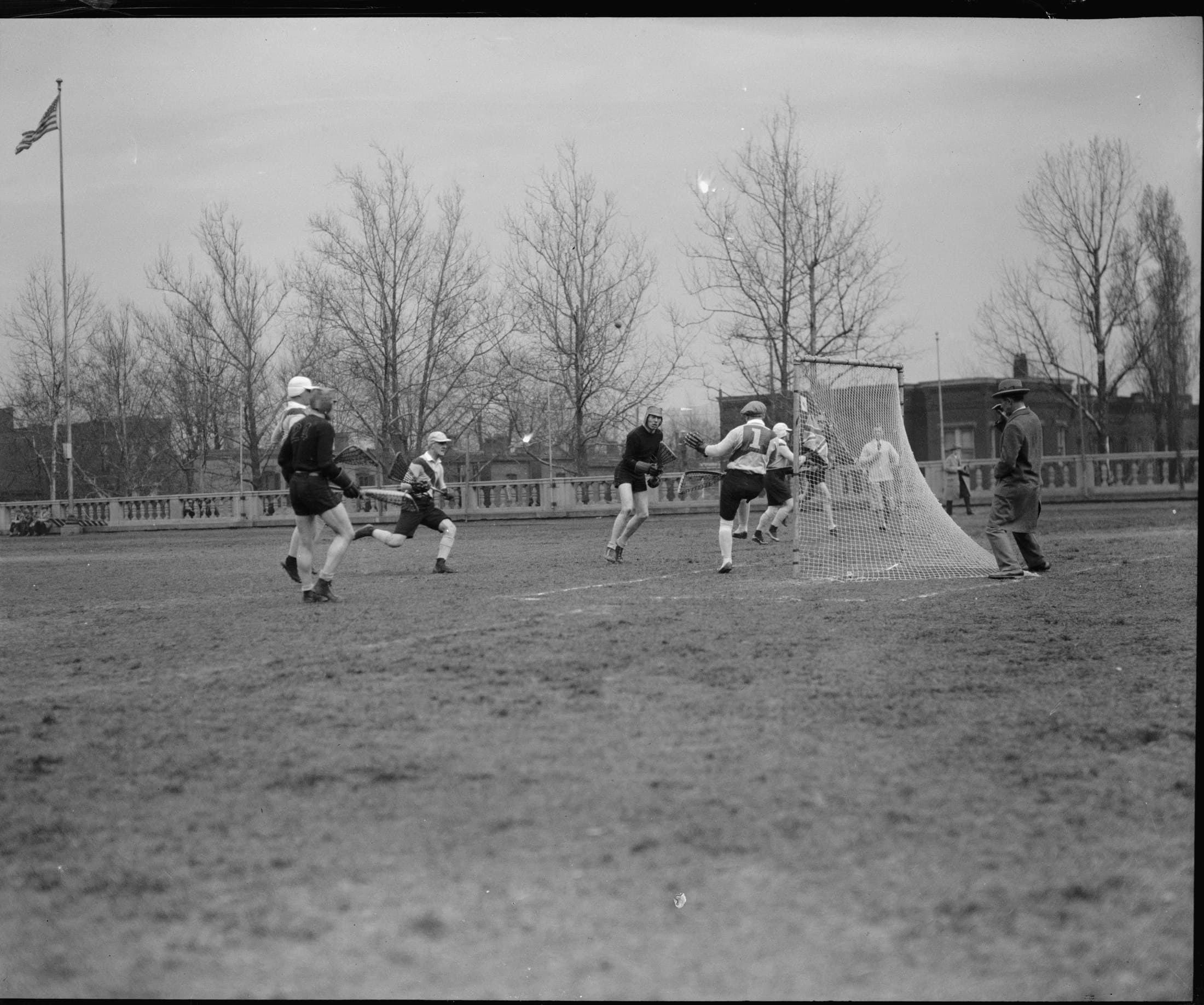
A University of Maryland and Oxford-Cambridge touring team play at a Washington, D.C. stadium on 2 April 1926, five years before the first professional box lacrosse season. The catalogue record does not name the players, so neither do we.[4]
The first professional indoor season ran in 1931. Box lacrosse was developed in Canada to use hockey arenas left empty during the summer.[12][2]
It is played on a hockey rink with the ice taken out — five runners and a goalie, boards keeping the ball in play. That is why our game is fast, tight and physical.[16][2]
Who thought of it first is not settled. Several accounts credit a Montreal player and referee, Paddy Brennan, experimenting in the early 1920s.[2][note]
And now
Lacrosse returns to the Olympic Games in Los Angeles in 2028, six a side. Whether the people who created the game will be there under their own flag is still not settled.[7]
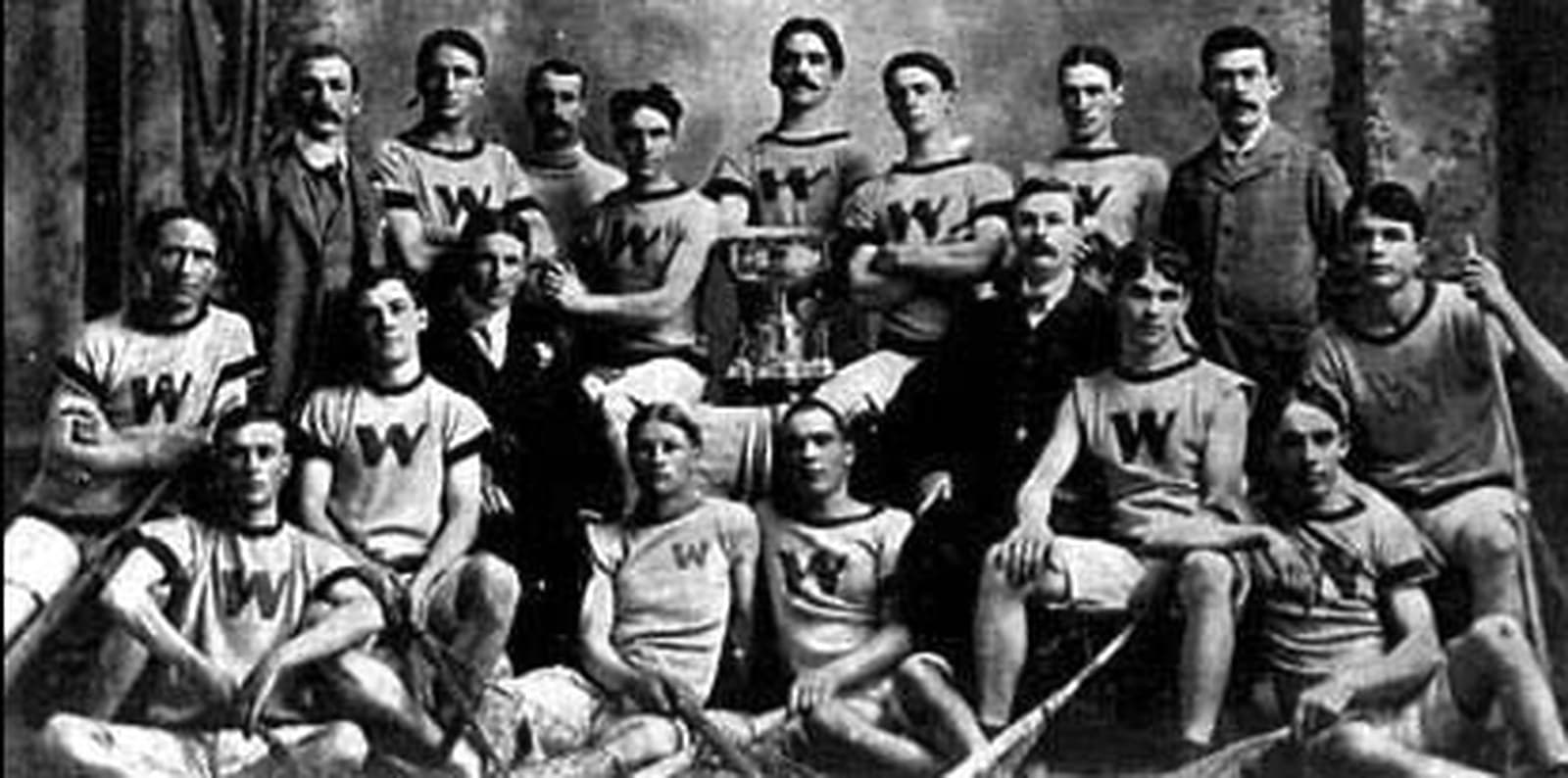
The Winnipeg Shamrocks, Olympic lacrosse champions at the 1904 St. Louis Games — the last time the sport gave out a gold medal, until it returns, six a side, in 2028.[5]
Where this came from
Every numbered marker above points here. Where our sources disagreed, we said so rather than picking the version that reads best.
- [1]Akwesasne, Mohawk territory — Traditional Lacrosse (opens in a new tab)
- [2]American Amateur Box Lacrosse Association — History of Box Lacrosse (opens in a new tab)
- [3]Haudenosaunee Nationals — History (opens in a new tab)
- [4]Justice Laws Website, Government of Canada — National Sports of Canada Act, S.C. 1994, c. 16 (opens in a new tab)
- [5]Mackinac State Historic Parks — Captain George Etherington, Michilimackinac's Unfortunate Commander (opens in a new tab)
- [6]Onondaga Nation — Lacrosse (opens in a new tab)
- [7]Onondaga Nation — Lacrosse will make the 2028 LA Olympics. Will the game's creators? (opens in a new tab)
- [8]Smithsonian, National Museum of the American Indian — The Creator's Game (opens in a new tab)
- [9]The Canadian Encyclopedia — Lacrosse: From Creator's Game to Modern Sport (opens in a new tab)
- [10]The Canadian Encyclopedia — Lacrosse (opens in a new tab)
- [11]The Canadian Encyclopedia — The Iroquois Nationals and the 2010 World Lacrosse Championships (opens in a new tab)
- [12]The Canadian Encyclopedia — Bill Isaacs (opens in a new tab)
- [13]The Ojibwe People's Dictionary, University of Minnesota — baaga'adowe (opens in a new tab)
- [14]USA Lacrosse Magazine — Indigenous Brilliance: A Conversation with 'Creator's Game' Author Allan Downey (opens in a new tab)
- [15]W. G. Beers, Lacrosse: The National Game of Canada (1869), via Wikisource — Appendix — the Laws of Lacrosse (opens in a new tab)
- [16]Wikipedia — Box lacrosse (opens in a new tab)
- [17]World Lacrosse — Passport impasse keeps Haudenosaunee home (opens in a new tab)
Photographs
- [1]George Catlin, “Ball-play of the Choctaw — Ball Up”, 1846–1850 · Smithsonian American Art Museum, 1985.66.428A · Public domain — the museum marks it “Free to use” (opens in a new tab)
- [2]William Notman, “W. G. Beers, Montreal, QC”, 1868 · McCord Stewart Museum, I-30326 · Public domain (opens in a new tab)
- [3]William Notman, “Kahnawake lacrosse team, Montreal, QC”, 1876 · McCord Stewart Museum, II-41679 · Public domain in Canada (opens in a new tab)
- [4]National Photo Company, “Lacross[e] game, U. of Md. & Oxford Cambridge team, [4/2/26]”, 1926 · Library of Congress, Prints and Photographs Division, LC-DIG-npcc-15666 · No known copyright restrictions — the Library of Congress states there are no known restrictions on the National Photo Company collection (opens in a new tab)
- [5]Unknown photographer, “‘Winnipeg Shamrocks’ lacrosse team, Olympic champions at the St. Louis Games of 1904”, 1904 · Manitoba Sports Hall of Fame (no accession number given) · Public domain in the United States and Canada — Crown copyright expired over 50 years ago, or photograph created prior to January 1, 1949 (opens in a new tab)
What we could not settle
- What is disputedThe familiar story is that “lacrosse” comes from the French word for a bishop's hooked staff. The Canadian Encyclopedia records a competing view from the historian Donald Fisher, who thinks it more likely came from the Mohawk name for the game. Sources also split between 1636 and 1637 for the first account, so we say only “the 1630s”.
- What is disputedThe capture is recorded by the people who run the fort today. Those mechanics are not in their account; they trace to a memoir published in 1809 and get repeated everywhere without one.
- What is disputedEvery source that names Brennan hedges it — “attributed to”, “a more plausible explanation”, “the roots are obscure”. The strongest-looking corroboration turned out to be the same sentence copied between two sites. A date of 1928 also circulates widely for box lacrosse and we could find no source for it at all.
- Why "Tewaarathon" is left untranslatedWe have left this one untranslated. The meaning usually printed rests on a single source, and others disagree — including on whether the word is Mohawk or Seneca. Better to print the word than the wrong meaning.
17 claims, 17 sources. If you find something here that is wrong, or told in a way it should not be told, we want to hear it — tell us and we will fix it.